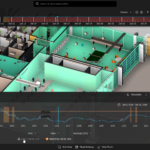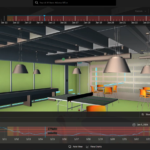


In a 2024 article, McKinsey & Company defined a digital twin as a “digital replica of a physical object, person, or process, contextualized in a digital version of its environment.” The concept of a digital twin dates to the 1960s when NASA used physical simulators to mirror spacecraft conditions, but the adoption of digital twin use has skyrocketed more recently, particularly within architecture, engineering, and construction. Why? Digital twins can be very effective for tracking data related to the functions and systems within smart buildings; data that helps owners realize operational efficiency goals, have a live visual of what’s working and what’s broken, and data that can inform business decisions.
What Is a Digital Twin in Construction?
Historically at handover of a construction project, building owners may have received a database of multiple system manuals, maintenance schedules, and hard copy floor plans for their facilities staff to use. This is equivalent to the dusty folder of home appliance and HVAC manuals many of us have tucked away in a drawer, only to be referenced when our dishwasher breaks. But a digital twin can offer a dynamic three-dimensional replica of every building asset all in one place. Unlike static drawings and scattered manuals, digital twins are live models that give owners and operators real-time insights about their facility. More smart building owners and operators are realizing the operational and cost benefits of adopting a digital twin.
How Digital Twins are Created
The creation of an effective digital twin for a smart building begins to take place during design and preconstruction using the drawings a technology designer or mechanical engineer might already be creating. Building Information Modeling (BIM) files, data-rich 3D models, serve as the foundational layer for a digital twin. These models contain more than geometry: they carry detailed attributes about every system and component in a building, from structural elements and mechanical equipment to electrical circuits and plumbing runs. When a project is also supported by a thorough set of construction drawings and as-built documentation, that information can be used to verify, refine, and populate the twin with accurate real-world data that reflects how the building was built, not just how it was designed. Once this static foundation is in place, the twin is brought to life by connecting it to the building’s live operational systems — sensors, meters, building management system (BMS) controllers, and other IoT devices — so that it begins receiving and reflecting actual data. The result is a dynamic model that bridges the gap between the building as it was designed, as it was built, and as it operates today.
“The quality of BIM deliverables and construction documents at project handover is very important, because the more thorough and accurate that data is, the more reliable and informative the digital twin will be,” said Emory Burch, Senior VDC Manager at Aptitude.
Real-Time Visibility into Every Smart Building System
The most effective digital twins standardize and corral every building system in one place to create a functional, intelligent tool that can be used for facility monitoring and collecting informative operational data. This data can be helpful in pinpointing system failures, tracking and reducing energy usage, understanding occupancy trends, and more. While the potential benefit of using a digital twin is clear, it’s important to note that not all software referred to as a ‘digital twin’ is created equal. It’s also key to understand that the software alone can’t achieve intended goals unless it’s built upon a comprehensive set of building assets.
Digital Twin Cost and Return on Investment Considerations
If you’re considering a digital twin for your smart building, there are a few things to be aware of before making the investment. Initial costs typically include platform licensing, implementation and commissioning fees, and the labor required to prepare and migrate BIM and as-built data into the system. Depending on the complexity of your building and the state of your existing documentation, data preparation alone can be a significant line item. Of course, the ideal creation of a digital twin occurs during a construction project with the BIM data serving the dual purpose of informing both the construction delivery and the digital twin.
Ongoing costs might include annual software subscriptions, integration maintenance as building systems are updated or replaced, and staff time for training and day-to-day use. That said, the ROI case for a well-implemented digital twin is strong. Energy optimization alone can yield measurable savings. Building owners who leverage real-time monitoring and predictive controls commonly report reductions in energy spend that, over time, offset the cost of the platform. Maintenance savings are another major driver: by shifting from reactive to predictive maintenance, building owners can extend equipment lifecycles, reduce emergency repair costs, and avoid the operational disruptions that come with unexpected system failures. Finally, a building with a current, data-rich digital twin is better positioned for future renovations, system upgrades, and even resale, as the twin provides a detailed operational history that would otherwise be difficult and expensive to reconstruct. The key is to model your expected ROI against realistic assumptions, not best-case scenarios, and to choose a platform that will align with the scale and complexity of your smart building.
Aptitude’s Approach to Digital Twins
Aptitude remains vendor and brand agnostic: Whether our clients need security cameras or a digital twin platform, our goal is not to peddle products but rather to offer solutions to meet clients’ needs. With this in mind, we work hard to stay informed of ongoing innovation in the smart building industry and ensure our staff is certified to design and install a wide range of products that will benefit our clients. To that end, Aptitude is a certified digital twin solution provider for Autodesk Tandem – one of the digital twin solutions on the market we’ve found successfully meets our clients’ needs.
“Our team has tested and will continue to test the use of various digital twin offerings to determine which are most effective for our clients,” said Chris Andrews, Technology Innovation Director for Aptitude. “Considering Autodesk products are a standard in construction that our teams already use daily, adopting Tandem has been a seamless way to transfer BIM models we create throughout design and construction. We’re grateful to have had the opportunity to work with the Tandem development team to help perfect their platform. That said, when we identify other options, it’s our responsibility to our partners to evaluate them thoroughly.”
When Aptitude employs Tandem, the scaffolding for what is eventually handed over to a client is powered by gathering design and construction Revit models. An independent data layer then connects the twin to live data from building systems, Computerized Maintenance Management System (CMMS) software, and Autodesk Build assets. The assets are tagged with standardized IDs using QR codes to give facility staff instant mobile access to data from the actual asset within the building. Aptitude presents all this information in the form of a unified dashboard for asset browsing, maintenance work orders, and facility health monitoring.
If you’re considering a digital twin solution for your next building project and have questions, Aptitude experts are here to help with complimentary consultations. Reach out for more information.